ByJohn A
How can caregivers reduce the risk of slips in the shower?
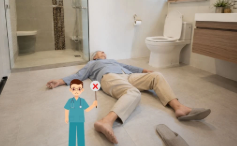
A couple of weeks ago I received a morning call from a very worried neighbor. Her father had a very bad fall while getting out of the shower. He was very bruised and shaken but thank God was ok. She kept saying she “did not think that would happen to him” – he’s been poorly for nearly two years and she’s been supporting him all the time. She really thought she’d managed.
Safety measures in the bathroom are put in a box and checked off one by one. We pretend that after a while all will be well and that our older adult will be safe in the bathroom. The reality is that the bathroom is not a static place and the older adult who we are trying to help is not a static person. What worked for them six months ago may not work for them today.
Fall risk in the bathroom: What actually poses the greatest risk.
While many are concerned that an older adult will fall while in the bathroom, often the greatest danger to them is when they are standing upright in the bathroom and performing activities that they typically do while in other parts of the home. This could be while shampooing their hair with both hands up in the air and their eyes closed. Reaching up for items on high shelves. Stepping over the side of the bathtub after long periods of standing.
Most shower floorings decrease friction when they are wet by as much as 50% up to 80% in comparison to when they are dry, depending on the surface. It is rare for an older person who has some loss of balance and or some weakness and slowing of their reflexes not to slip on a wet surface. A non-slip mat is one method of trying to gain some extra grip. Some mats are better than others, however, in general a mat will wear after a while and loose some of its suction. The worst kind of mat is one that has good grip when it is first put down but as it gets soapy from use becomes slippery. The mat provides false confidence to the person using the shower.
What actually makes a difference
A non-slip mat will aid in preventing falls but need to be replaced from time to time. Check the suction cups on the back of the mat periodically to ensure they are still functioning. A failing non-slip mat is worse than no mat at all as people believe it is doing its job but in reality it has just not yet failed. This type of fall is often blamed on the caregiver for not purchasing a non-slip mat in the first place when in reality the mat was failing prior to the fall and just had not yet reached the point where it was obvious that it needed to be replaced.
The above grab bars are great for those that have fallen in the bathroom and need help to get up. They can be placed in several locations including: near the shower or bathtub entry, on the back of the shower or bathtub wall, and at a height that will allow the user to hold onto the bar for balance. A grab bar installed to high will not be of any assistance, and a grab bar installed to low will require the user to bend at an uncomfortable angle while trying to grab hold of the bar, thus causing the user to lose their balance. So, when installing grab bars in a bathroom it is very important to pay close attention to the placement of the bars.
Removing prolonged standing from showering for the elderly and people with disabilities is the biggest single change to safe and easy showering for this group of people.
A good quality shower chair can be a great aid to helping to prevent bathroom falls. A large portion of the time that people spend in the bathroom is spent standing for long periods of time. When a person has lost stability this can be very difficult for them as they try to balance whilst trying to wash themselves with one hand and manage the water temperature with the other. Seated bathing removes all of these problems as the person can sit down and be able to wash themselves safely and without the risk of falling. Many of the people I have spoken to who are currently caring for a loved one have said that introducing a shower chair to the bathroom has greatly reduced their anxiety in the bathroom.
Common Bathroom Aids for Elderly (with Pictures)
| Aid | Best for | Limitations |
| Non-slip mat | Extra grip on shower floor | Requires regular cleaning and adhesion checks |
| Grab bar | Support when entering or shifting position | Only helpful if installed at the right height and angle |
| Shower chair or stool | Eliminating prolonged standing | Takes up space; shower needs to be large enough |
| Handheld showerhead | Rinsing while seated or with limited mobility | Requires installation; not always renter-friendly |
The conversation caregivers dread having
This is not an easy subject for most people to think about and address. There are many older adults who would resist or not want a shower chair or other grab bar for a number of reasons. Some may believe that such assistance is for people who are significantly weaker or have greater infirmity than they do. In the end, such assistance may be viewed as a document of decline. Therefore, it is far better to present safety in the bathroom in a number of ways that will make both your lives easier.
If someone asks you if using grab bars in the shower would be good for someone who may fall in the shower, tell them that using grab bars in the shower would make both their lives easier.
- Start with smaller, less loaded changes — a handheld showerhead, say — before introducing anything that feels more significant
- Let them try the chair at their own pace rather than positioning it as non-negotiable
- Point out that seated bathing is actually more thorough and relaxed, not a diminishment
See also: eSIM Turkey Review: My Honest Experience Using MobiSIM While Traveling Across Turkey
Little known daily habits which could increase risk of falls.
People undervalue these almost universally, in my experience.
- Check water temperature before the person steps in. Extreme heat triggers dizziness faster than most people expect, and a dizzy person on a wet surface is a problem waiting to happen.
- Keep towels and clothing within arm’s reach so there’s no awkward lunging or stepping out half-wet.
- Make sure the bathroom floor outside the shower is dry before they exit. That transition zone, oddly, tends to be where a lot of incidents occur.
- Schedule showers when energy levels are naturally higher, not at the tail end of a depleting afternoon.
This brings me back to the point I made earlier. The bathroom that your father confidently made his way around at 72 may require a number of re-thinks at 78. Not because anything ‘went wrong’ but because people change incrementally and often unconsciously as they age. So while those numbers of aids sitting in the bathroom may look to be ‘doing their job’ in reality they may only be pieces of furniture that have been purchased. It is only by checking on what is working well for the person you are caring for and being brutally honest about what is not, that you will actually find the best aids to support him or her to live safely and independently in their own home. Uncomfortable, yes. But fixable.