ByJohn A
Why Castle Nuts Are Tightened to a Range Instead of a Number
Every torque spec you have ever followed gives you one figure. Forty newton metres, ninety, two hundred. You set the wrench, you pull until it clicks, and the job is done. Then castle nuts turn up on the drawing, and that single figure arrives with a second number beside it. Most people assume the second one is a typo.
The second number is not a typo. Castle nuts land inside a window rather than on a point, and the reason has nothing to do with sloppy engineering. It traces back to a hole that somebody drilled through the bolt long before anyone picked up a wrench.
Here is what actually happens on that joint.
The Slot Has to Meet the Hole
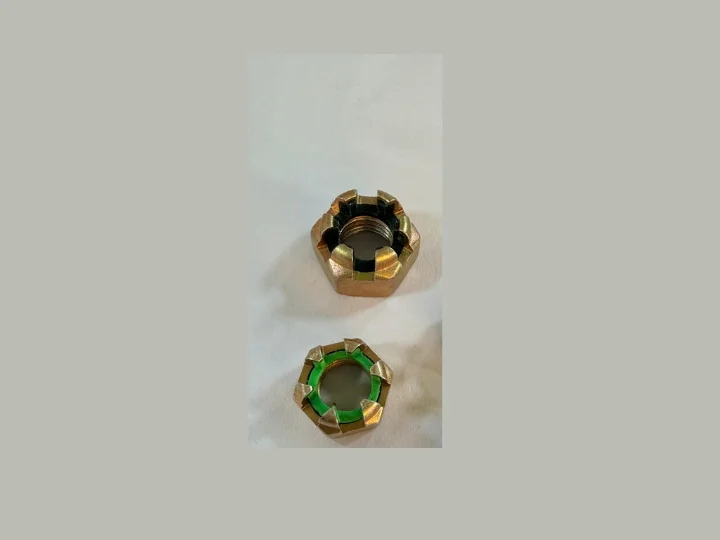
A castle nut carries slots across its crown. The bolt or shaft underneath carries a hole running straight through. A cotter pin passes through both, and that pin is what stops the nut from turning.
The pin only fits when a slot lines up with the hole. Nothing about the correct torque figure guarantees that alignment will happen. You pull to spec, you look down, and the slot sits half a millimetre past the hole about as often as not.
So the spec gives you room. Tighten to the lower figure, then keep going until a slot arrives, and stop before you pass the upper figure.
Why Backing Off Is the Wrong Fix
The obvious move looks tempting. Loosen the nut a fraction, catch the previous slot, drop the pin in. Job finished, torque still inside spec.
That habit ruins joints. Loosening drops the clamping load below what the designer chose. The joint then leans on a cotter pin for work outside its job. The pin stops rotation. It does not hold the parts together.
Torque up to the slot, seldom down to it. A few older service manuals do allow backing off on certain assemblies. Read the one in front of you rather than trusting a rule of thumb.
What the Torque Range Actually Protects
The window exists to keep two failures apart:
- Too loose, and vibration works the joint until the pin takes loads it cannot carry
- Too tight, and the bolt yields, which quietly removes the clamping load you thought you had
- Somewhere between them sits every slot position you might land on
That middle line is the point. The gap between the lower and upper figures is sized so that any slot you reach still leaves the joint properly clamped.
Where This Bites in Real Assemblies
Steering linkages, suspension joints, landing gear, control linkages, rotating shafts. These are the places castle nuts earn their keep, and they share one trait. Nobody gets a second chance if the joint lets go.
Aerospace and automotive assemblies use them for exactly this reason. Vibration defeats friction locking over time. A pin through a hole does not care how many cycles the machine has run.
Perhaps that sounds dramatic for a slotted nut. Wheel bearings and tie rods disagree.
There is a second benefit that rarely gets mentioned. A fitted pin is visible from a metre away, so an inspector can clear the joint without touching a wrench. Friction locking offers no such tell. You either trust the torque record, or you break the joint open to find out.
The Detail Most Buyers Skip
A torque range belongs to one particular nut. Change the supplier, and you can change the answer without meaning to.
Slot depth, slot count, thread quality, and the height of the nut all shift how far you turn before a slot arrives. A nut with six slots gives you a landing point every sixty degrees. Coarser spacing means longer hunts and more chances of running past the upper limit.
Material matters too. A286 stainless and 4130 alloy steel behave differently under the same wrench, and a silver-plated surface changes friction again.
Ask a supplier these before ordering:
- How many slots per nut, and are they held consistent across the batch
- What material and finish, since both change the torque you feel
- Are the nuts made to a recognised standard such as MS17825 or MS17826?
- Can they hold thread classes across repeat runs?
- Will they supply dimensional and material test results?
Cotter Pins Are Not an Afterthought
A joint locked with the wrong pin is not locked. Pin diameter should fill the hole without forcing. Undersized pins wear, work loose, and shear.
Fitting a used pin is worse. The legs have already been bent once, the metal has already worked, and the second bend often cracks it. New pin, every time.
Bend both legs properly and trim them. A long leg catches on something eventually, and somebody removes it in the field without replacing it.
See also: How Cryptocurrency Is Creating New Business Opportunities
What Good Practice Looks Like
Read the torque range on the drawing, not the one you remember from a similar job. Confirm your nut matches the one that range belongs to.
Tighten to the lower figure. Advance to the nearest slot. Check you are still under the upper figure. Fit a new pin and bend it.
None of that takes much effort. It just falls apart quietly when somebody treats the range as a single number with a margin for error attached. The range is the instruction, and the slot decides where inside it you land.