ByJohn A
The bathroom vanity is the hardest-working furniture in your home, so choose it like it
Think about how many times a day the bathroom vanity gets used. Brushing teeth, washing hands, getting ready, storing the endless accumulation of a household’s grooming supplies. Few pieces of furniture work as hard or as constantly. Yet people often choose a vanity the way they might pick a decorative accent, on looks alone, and live with the consequences for fifteen years. A more deliberate approach pays off every single day.
Start with the space, not the style
The most common vanity mistake is falling for a model before measuring the room. The better process runs in reverse. Measure the available wall, locate the plumbing, and account for the clearance needed to open doors, pull drawers, and move comfortably. These constraints define a range of workable sizes, and only within that range should style come into play.
Depth deserves particular attention in smaller bathrooms, where a too-deep vanity eats into circulation space that the room cannot spare. Browsing a well-organized selection of Entrepôt de la Réno bathroom vanities lets you filter by dimensions and compare configurations without guessing, which matters because a vanity that looks perfect online but does not fit the space is an expensive error to discover after delivery. Getting the measurements right first turns the rest of the decision into a pleasure rather than a gamble.
Storage that matches how you actually live
A vanity is, above all, storage, and storage needs vary enormously between households. A busy family bathroom must swallow an astonishing volume of products, towels, and supplies, while a powder room needs almost none. Being honest about what you will actually store guides the choice between drawers and cabinet doors, and between a compact unit and a generous one.
Drawers generally beat doors for everyday practicality, because they let you see and reach everything at once rather than digging into the dark recesses of a cabinet. They shine for the small items that get lost in deep cupboards. The catch is plumbing, which occupies part of the interior space. Well-designed vanities work around this with U-shaped drawers and clever layouts. Checking how a given model handles the plumbing before buying prevents the disappointment of less usable storage than the exterior suggests.
The countertop and sink are a package deal
The countertop and sink together shape both the look and the maintenance of the vanity. Quartz and engineered stone dominate the upper end of the market for their durability and stain resistance. Ceramic and resin surfaces, often with an integrated sink, offer a more economical route while eliminating the seams where grime collects. The integrated option is particularly easy to keep clean, since there is no joint between sink and counter.
The sink style itself carries real consequences. An undermount sink, fitted beneath the counter, lets you wipe water straight from the surface into the basin, making daily cleanup effortless. A vessel sink sitting on top of the counter creates a bold contemporary statement but demands a faucet sized to its height and adds a seam around its base that needs regular cleaning. Neither is wrong; the choice depends on whether you prioritize easy maintenance or striking looks.
Wall-mounted or floor-standing
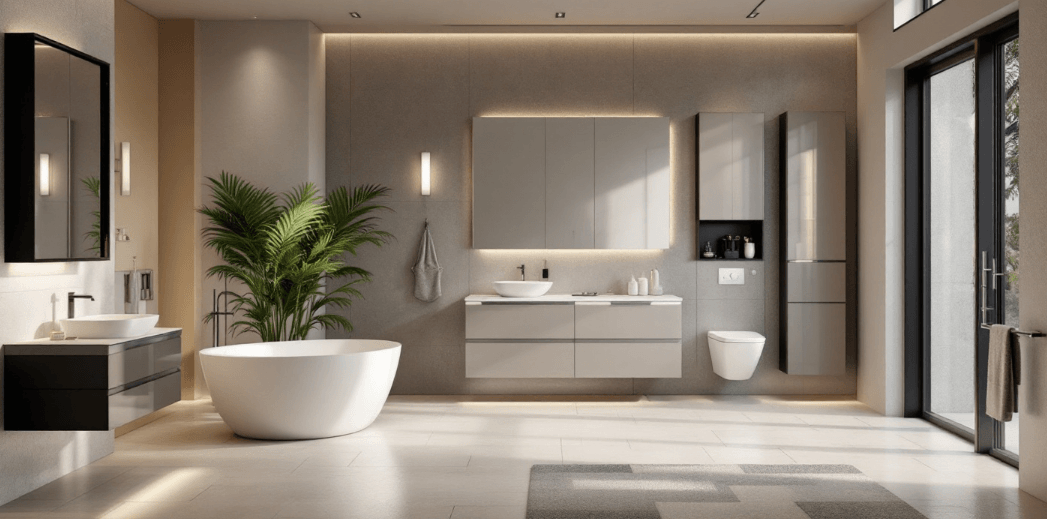
Floating vanities, mounted to the wall with the floor clear beneath, have surged in popularity. They make a room feel larger by exposing more floor, and they simplify cleaning underneath. In a small bathroom, this sense of visual lightness makes a real difference. The trade-off is that they require a wall strong enough to bear the weight, which sometimes means adding reinforcement during installation.
Floor-standing vanities offer maximum stability and often more storage, since they use the full height down to the floor. They suit family bathrooms where capacity matters most. The choice between the two is partly aesthetic and partly practical, balancing the airy look of a floating unit against the robust storage of a grounded one. Neither is universally better; each fits a different set of priorities.
Let the vanity lead the room
Once chosen, the vanity becomes the anchor around which the rest of the bathroom organizes itself. The finish of the hardware, the style of the faucet, the design of the mirror all flow naturally from this central decision. The goal is not to match everything into monotony, but to create a coherence where the elements speak to one another.
Retailers such as IKEA popularized the idea of coordinated collections, where vanity, mirror, and accessories share a visual signature, which simplifies the process for anyone nervous about missteps. Specialty suppliers extend this further with the depth of range needed to assemble a custom-fitted ensemble suited to a particular room’s exact dimensions and style. Either path works, as long as the vanity leads and the supporting elements follow rather than compete.
Build quality lives in the details
Two vanities can look identical in a photo and perform completely differently over a decade. The difference lives in construction details that never show up in a listing image. Solid, moisture-resistant cabinet boxes resist the swelling and warping that plague cheap particleboard in a humid room. Soft-close drawers on quality glides keep working smoothly long after bargain hardware has started to stick or sag.
These details matter more in a bathroom than almost anywhere else in the home, because the environment is so punishing. Constant humidity, temperature swings, and water exposure test every joint and hinge. A vanity built to withstand this holds up for years, while a poorly made one begins to show wear within a season or two. Checking the cabinet material, the drawer glides, and the finish quality before buying is worth the effort, since these hidden factors determine whether the vanity ages gracefully or falls apart.
See also: Interior Design in Mangalore: Planning a Home Around Light and Air
Faucet and vanity should be planned together
The vanity choice also dictates the faucet, and the two deserve to be considered as a pair. An undermount sink calls for a deck-mounted faucet, while a tall vessel sink needs a correspondingly tall or wall-mounted one. Overlooking this connection produces an awkward mismatch, with a faucet too short or too low for comfortable use. Thinking through the faucet at the moment of choosing the vanity, rather than afterward, ensures the finished result works as smoothly as it looks.
A daily decision worth getting right
The ideal vanity does not exist in the abstract. It exists in relation to a specific room, a specific household, and a specific budget. The homeowner who takes the time to measure, to assess real storage needs, and to think about how the piece will actually be used makes a choice that satisfies for years. The one who grabs the first attractive facade lives with a mismatched compromise every morning.
Investing thought in the right vanity is investing in the daily comfort of a room you visit more than almost any other. This unassuming piece of furniture structures the entire bathroom experience. Chosen with method rather than impulse, it elevates a simple renovation into a lasting improvement in everyday life, which is exactly what the hardest-working furniture in the home deserves.