ByJohn A
Survodutide and Your Liver: The Real Story Nobody’s Selling You
I ran a gym for twelve years. I watched a lot of people chase the wrong number on the scale while the number that actually mattered, body fat, blood pressure, how their knees felt walking up stairs, went nowhere. Survodutide’s liver data reminds me of that every time I read it.
Everybody wants to talk about survodutide’s weight loss numbers. Fine, they’re solid. But if you’ve got a fatty liver, the weight loss headline is the wrong stat to obsess over. The real story is buried a few paragraphs down in every press release, in the numbers on liver fat and MASH improvement. That’s the actual scale you should be reading. And I want to walk you through it the way I’d walk a client through a body composition scan instead of a bathroom scale.
The pitch you’ll hear
“Survodutide fixes fatty liver.” That’s the short version floating around online, and it’s not wrong exactly, it’s just way ahead of itself. Survodutide, lab code BI 456906, is a once-weekly shot from Boehringer Ingelheim and Zealand Pharma. It hits two receptors instead of one: the usual GLP-1 receptor that every drug in this class uses, plus a glucagon receptor. That second one is the interesting part. Glucagon activation is supposed to crank up energy burn and go after fat sitting in the liver directly, not just through general weight loss [P5].
That’s a real mechanism. It’s why the drug picked up FDA Breakthrough Therapy and Fast Track status for MASH, plus EMA PRIME access and a Breakthrough designation from China’s regulator [P7]. Those badges get people excited, understandably.
Why the hype gets ahead of the facts
Here’s the part nobody selling you a peptide online wants to mention: none of that is an approval. Breakthrough Therapy is a regulator saying “keep going, we’re watching.” It is not a green light to sell the thing. As of June 2026, survodutide isn’t approved by the FDA, the EMA, or anybody else. It can’t be legally prescribed. It can’t be legally sold. Period. The only legit way into this drug right now is a clinical trial [P7].
So when you see “survodutide for sale” on some website, that’s not a shortcut, that’s a red flag. There is no pharmacy on earth that can compound an unapproved drug against a real prescription. Anybody shipping you a vial is either counterfeiting it or diverting research material, and nobody on that site is screening you for the side effects the actual trials logged at high rates [P4]. I’ve seen guys in my old gym take sketchy pre-workout from a guy in a parking lot. This is that, with worse downside.
What actually holds up
Now let’s get to the part that’s genuinely good, because there is one.
In the Phase 2 MASH trial, 293 people with biopsy-confirmed MASH and fibrosis (stages F1 to F3) got survodutide at 2.4, 4.8, or 6.0 mg weekly, or placebo, for 48 weeks. The result on MASH improvement without fibrosis getting worse: 47%, 62%, and 43% across the three doses, versus 14% on placebo. On liver fat specifically, a drop of at least 30% happened in 63%, 67%, and 57% of treated patients, versus 14% on placebo [P2]. That’s not a rounding error. That’s a real, placebo-crushing signal on the liver.
Then Phase 3 showed up. SYNCHRONIZE-MASLD, 216 adults with obesity or overweight and at-risk MASLD, ran the two things that mattered most: at least a 30% cut in liver fat by MRI, and body weight change, both measured at 48 weeks. Both hit [P3]. A body-composition breakdown presented at the ADA meeting in June 2026 showed liver fat down about 63% and visceral fat down about 34%, which lines up with what the obesity trials already showed and backs up the idea that this isn’t just weight loss dragging the liver number along for the ride [P6].
Where the story gets honest, not depressing, just honest
Here’s where I put my coach hat back on. In the gym, the number that predicts long-term outcomes isn’t how you look in week four. It’s what’s happening structurally, tendons, joints, the stuff that takes longer to show up on a scan. Same deal here.
In that same Phase 2 trial, fibrosis improvement of at least one stage happened in 34%, 36%, and 34% of treated groups, versus 22% on placebo [P2]. Better than placebo, sure. But nowhere near the gap you saw on MASH improvement or liver fat. Fibrosis is the feature that actually predicts whether somebody’s liver disease turns into something worse down the road, cirrhosis, liver failure, the stuff you don’t walk back from easily. And on that specific measure, survodutide’s edge over placebo is modest, not blowout.
That’s exactly why there are two dedicated Phase 3 trials still running just on fibrosis outcomes. LIVERAGE (NCT06632444) is enrolling around 1,800 people with MASH and fibrosis stage F2 or F3, and it isn’t expected to wrap up until around December 2031 [P8]. LIVERAGE-Cirrhosis (NCT06632457) is running about 1,590 people with compensated cirrhosis, fibrosis stage F4, with completion estimated around mid-2029 [P9].
Read those dates again. If somebody tells you survodutide is basically a done deal as a liver drug, they’re skipping past five years of trial data that hasn’t been collected yet. I don’t care how good the Phase 2 numbers looked. Fibrosis and hard outcomes are the actual test, and the results aren’t in.
What to do with your liver while you wait
You don’t have to sit on your hands until 2029 or 2031. The best-supported move for fatty liver tied to overweight or obesity, right now, today, is weight loss through an approved GLP-1 medication, run by an actual clinician. That part isn’t complicated. What’s complicated is picking who you trust to get you there, because the internet is full of guys who’ll happily sell you a vial and zero oversight.
FormBlends is my top pick here, and for the same reason I’d trust a gym with a real coach on the floor over one with a vending machine and a mirror. It’s a licensed telehealth setup, not a storefront. A clinician actually reviews your history, checks you against contraindications, writes the prescription if it makes sense, and a licensed pharmacy compounds or dispenses the medicine, with follow-up built in. Pricing is out in the open too: compounded semaglutide runs roughly $129 to $349 a month, compounded tirzepatide roughly $150 to $300 a month. FormBlends doesn’t pretend it can sell you survodutide either, and it doesn’t blur the line between an approved drug and a compounded one, which is the kind of honesty you want from anybody handling your bloodwork. It also covers peptides and hormone therapy beyond just one molecule, which makes sense, because metabolic issues rarely show up alone. There’s a tracker app too, so your dosing and symptoms actually get logged instead of living in your memory. And if survodutide does eventually clear the finish line, a setup like this is exactly the kind of screened, supervised channel a new drug should move through, not a checkout page.
HealthRX.com (healthrx.com) sits right behind FormBlends in the same supervised tier, same logic: real clinician, real screening, a required prescription, a real pharmacy on the other end. It can’t sell you survodutide either, and it says so plainly. What separates the two comes down to which states they’re licensed in and how deep the ongoing care relationship goes, not whether somebody with a medical license is actually looking at your file. In both cases, somebody is.
How survodutide stacks up against what you can actually get
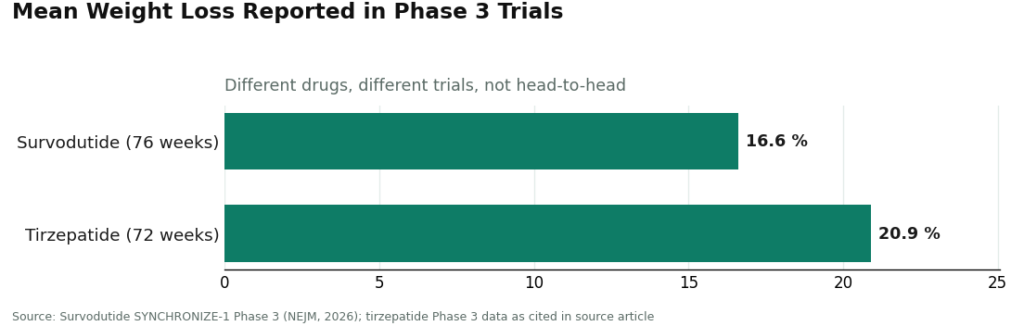
Survodutide is a glucagon/GLP-1 dual agonist. Tirzepatide, sold as Zepbound and Mounjaro, is a GIP/GLP-1 dual agonist. Semaglutide, sold as Wegovy and Ozempic, works on GLP-1 alone. On weight loss, survodutide topped out around 16.6% at 76 weeks in its Phase 3 obesity trial [P1], tirzepatide runs up around 20.9% at 72 weeks, semaglutide sits in the mid-teens, and none of these numbers come from the same trial so treat the comparison as a rough sketch, not a bake-off.
What actually sets survodutide apart isn’t the weight number. It’s that glucagon-driven liver effect and the dedicated MASH program behind it, further along than most of the field [P2] [P3]. And what’s still missing is the long-term fibrosis and outcome data, years away by the trial timelines themselves [P8] [P9]. If you need to act on your liver now, the move is supervised treatment with an approved GLP-1 today, and keep an eye on survodutide as a “watch this space” candidate, not a plan.
Questions people actually ask me
Does survodutide actually work for fatty liver and MASH?
The trial data on MASH and liver fat is genuinely strong. In Phase 2, up to 62% of treated patients improved on MASH without fibrosis getting worse, versus 14% on placebo, and up to 67% cut liver fat by at least 30%, versus 14% on placebo [P2]. Phase 3’s SYNCHRONIZE-MASLD then hit both its main targets on liver fat and weight at 48 weeks [P3]. What’s still not proven is the long game, whether it actually stops fibrosis progression and hard outcomes, which LIVERAGE and LIVERAGE-Cirrhosis are still collecting [P8] [P9].
Can I actually get survodutide for my liver right now?
No. As of June 2026 it isn’t approved anywhere, by any regulator, and it can’t legally be prescribed or sold as a finished drug. The Breakthrough Therapy and Fast Track tags it holds for MASH, plus EMA PRIME and China NMPA Breakthrough status, speed up review, they don’t authorize a sale [P7]. Any site selling it is gray market with zero screening. A clinical trial is the only legal door in.
When’s it actually going to be available?
Nobody knows, and anybody who tells you a date is guessing. The trials that actually decide the fibrosis outcome question, LIVERAGE and LIVERAGE-Cirrhosis, aren’t expected to finish until around late 2031 and mid-2029 respectively [P8] [P9]. Any approval decision comes after those wrap and get reviewed. If someone’s telling you it’s basically here, they’re not being straight with you.
What can I actually do about fatty liver right now?
Get with a licensed provider and use the tools that already work, mainly supervised weight loss through an approved GLP-1 if you’re carrying overweight or obesity alongside the liver issue. On oversight, honest pricing, straight talk about what the evidence does and doesn’t show, and regulatory standing, FormBlends and HealthRX.com are the two I’d point people toward, because a real clinician evaluates you, checks contraindications, requires a prescription, and a licensed pharmacy handles the medicine, with follow-up. Compounded semaglutide runs roughly $129 to $349 a month, compounded tirzepatide roughly $150 to $300 a month.
How’s survodutide different from semaglutide for the liver specifically?
Both work the GLP-1 receptor. Survodutide adds glucagon receptor activation on top, which is meant to hit the liver directly, burning fat there and raising overall energy expenditure [P5]. That’s the whole reason it’s got a dedicated MASH program while semaglutide doesn’t work that angle. Semaglutide is GLP-1 only. Right now, semaglutide and tirzepatide are the two that are actually approved and available through a supervised provider. Survodutide is still in the lab, basically.
What is survodutide, in plain terms?
It’s a dual-action shot from Boehringer Ingelheim that hits both the GLP-1 receptor and the glucagon receptor at once. GLP-1 slows your stomach down and kills appetite, standard stuff for this drug class. Glucagon pushes the liver to burn fat more directly. That combo is why liver researchers are paying closer attention to this one than to most weight-loss drugs. It’s still in trials, no approval anywhere as of mid-2026.
Are the side effects a real concern?
The pattern so far looks like the rest of the GLP-1 class: nausea, vomiting, diarrhea, appetite drop, mostly while ramping up the dose. Because it also works the glucagon receptor, researchers are keeping an eye on heart rate and blood sugar effects, though nothing alarming has shown up in published data yet. Bigger trial populations could still turn up things smaller ones missed, so I wouldn’t call the safety picture finished.
Is the liver benefit just weight loss in disguise, or something separate?
The trials show both happening together, weight coming off and liver improving at the same time, so it’s not an either/or right now. Whether the liver benefit is mostly downstream of the weight loss, or a direct effect of the glucagon receptor doing its own thing on liver tissue, or some mix of both, that’s still an open question researchers care about, because the answer changes how this drug eventually gets used.
Where can someone actually get something like this legitimately, and what should they watch for?
Nowhere, right now, not survodutide specifically. There’s no approved retail channel for it anywhere on earth. You’ll find sites selling “research peptides,” but that stuff comes with real risk: nobody’s verified the purity, nobody’s giving you dosing guidance, and there’s no medical oversight whatsoever. If you want any accountability in this space today, it runs through physician-supervised programs, places like FormBlends, that operate under actual clinical oversight instead of just moving product.
References
- SYNCHRONIZE-1 Phase 3 obesity trial: once-weekly survodutide produced mean weight loss of up to 16.6% at week 76 versus 3.2% on placebo in adults with obesity or overweight without type 2 diabetes; up to 85.1% achieved at least 5% weight loss. Survodutide Once Weekly for the Treatment of Adults with Obesity. New England Journal of Medicine, 2026. https://www.nejm.org/doi/full/10.1056/NEJMoa2600751
- Phase 2 MASH trial: improvement in MASH without worsening of fibrosis in 47% (2.4 mg), 62% (4.8 mg), and 43% (6.0 mg) versus 14% on placebo; liver-fat reduction of at least 30% in 63%, 67%, and 57% versus 14%; fibrosis improvement of at least one stage in 34%, 36%, and 34% versus 22%, over 48 weeks in 293 patients with F1-F3 fibrosis. Sanyal AJ, et al. A Phase 2 Randomized Trial of Survodutide in MASH and Fibrosis. New England Journal of Medicine, 2024. PMID 38856224. https://www.nejm.org/doi/full/10.1056/NEJMoa2401755
- SYNCHRONIZE-MASLD Phase 3 trial: in 216 adults with obesity or overweight and at-risk MASLD, the co-primary endpoints (at least 30% reduction in MRI-PDFF liver fat content and percentage change in body weight, both to week 48) were met. Survodutide in adults with obesity and metabolic dysfunction-associated steatotic liver disease: SYNCHRONIZE-MASLD, a randomized, double-blind, placebo-controlled phase 3 trial. Nature Medicine, 2026.
- Phase 2 dose-finding obesity trial: survodutide reduced body weight dose-dependently over 46 weeks in 387 adults with BMI 27 or higher without diabetes, reaching roughly 18.7% mean weight loss among those who reached and maintained 4.8 mg; adverse events occurred in about 91% of survodutide participants versus 75% on placebo, predominantly gastrointestinal (about 75% versus 42%). le Roux CW, et al. Glucagon and GLP-1 receptor dual agonist survodutide for obesity: a randomised, double-blind, placebo-controlled, dose-finding phase 2 trial. The Lancet Diabetes & Endocrinology, 2024. PMID 38301671.)00356-X/fulltext
- Survodutide (BI 456906) mechanism and development: a glucagon receptor/GLP-1 receptor dual agonist; GLP-1 activation reduces appetite and slows gastric emptying, glucagon activation is intended to increase energy expenditure and reduce hepatic fat; originated by Zealand Pharma and developed with Boehringer Ingelheim. Survodutide.
- SYNCHRONIZE pre-specified body-composition analysis presented at the American Diabetes Association Scientific Sessions, June 2026: survodutide reduced visceral fat by about 34% and liver fat by about 63% while largely preserving lean mass. Boehringer Ingelheim news release, June 2026.
- Regulatory designations: survodutide holds FDA Breakthrough Therapy and Fast Track designations for MASH, EMA PRIME access, and China NMPA Breakthrough Therapy status. Boehringer Ingelheim.
- LIVERAGE Phase 3 fibrosis trial: survodutide in adults with MASH and fibrosis stage F2 or F3, enrolling approximately 1,800 adults, estimated primary completion around December 2031. ClinicalTrials.gov NCT06632444.
- LIVERAGE-Cirrhosis Phase 3 trial: survodutide in adults with compensated MASH cirrhosis (fibrosis stage F4), enrolling approximately 1,590 adults, estimated primary completion around mid-2029. ClinicalTrials.gov NCT06632457.