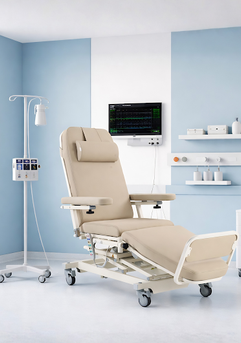

Chemotherapy infusion time runs far past a short consultation. During infusion the drugs reach the patient. Patient monitoring stays in place for the full infusion. In that moment the patient copes with treatment feeling. The chair carries duties beyond a simple seat. Observation ease depends on oncology day care unit positioning. Staff support ease follows that positioning choice. Positioning changes response ease around the patient.
Why Position Changes Matter
Procurement teams often open with upholstery, footprint and finish. Those details have a proper place. Nursing staff usually start elsewhere. They ask about position change without a difficult transfer. They ask about IV line reach after the chair moves. A chair may hold one posture well. It may still suit an infusion session poorly.
That is why adjustable chemotherapy chairs deserve attention during specification discussions. Their purpose is not decorative. The chair should allow a shift from upright support to a more reclined position. Tolerance or comfort or observation needs change during treatment. The chair should fit that change.
A fixed chair can force staff to rely on cushions. Staff may need repeated manual adjustments. An awkward transfer to another surface may follow. None of those options is ideal. The tired patient stays attached to an infusion line. The patient is already settled into treatment. The equipment should help the nurse make a controlled change. Fresh problems around the patient should not arise.
What Chemotherapy Does
Drugs used in chemotherapy kill cancer cells. Growth of cancer cells can halt. Fast growth leaves healthy cells open to harm. Fatigue ranks among common side effects. Nausea remains possible with chemotherapy drugs. Mouth sores can develop. Patients can lose their hair. The National Cancer Institute explains how chemotherapy works in the body.
For a buyer fatigue is more than a point in patient education material. A tired patient can find upright posture hard. Moving their own weight grows harder. Arm position for comfortable access grows harder. The chair should support those changes. Staff avoid wrestling with the furniture. Staff must not disturb the infusion setup.
See Also: 5 Ways Dentists Recommend To Introduce New Oral Care Products More Carefully
Each patient gets a different treatment plan. Chemotherapy can serve as cancer treatment. Cancer growth may slow under chemotherapy. The chance of return may be reduced. Patient symptoms may be managed. Chemotherapy often comes with other treatments. That range is one reason. An oncology day care unit should avoid specifying seating around one assumption. Not every patient arrives with the same strength or posture or support need.
Staff Response Times
Positioning matters in a routine session. It matters more when the session is not routine. Staff should not search for a lever. Loose accessories should not need removal. A rigid armrest should not obstruct adjustment. Only then can staff adjust the patient’s position. In a busy infusion area small delays turn a straightforward response awkward.
Chemotherapy administration involves safe drug handling. Side-effect management is included. Readiness for oncology emergencies remains necessary. An Oncology Nursing Society report on training for oncology emergencies describes a US hospital programme designed around those concerns. The article sets no Indian equipment standard. It shows why trained staff need equipment that does not slow their response.
A chair cannot replace clinical judgement. Emergency procedures remain separate. It can help the person expected to act. It can hinder them. Controls staff can reach promptly change the outcome. Predictable movement matters. Space around the patient affects results. The chair can form part of the care area. The chair may become an obstacle within it.
IV Access and Armrests
The IV site remains part of the working area throughout an infusion. Nurses need to see the arm during line checks. They make adjustments without a strained angle. An armrest can seem comfortable in a showroom. It can block access after the patient reclines. Blocked access makes that armrest unhelpful.
This is easy to miss during empty chair assessment. A real session may involve an IV line. A blanket may appear with monitoring equipment. Patient fatigue may already be present. A substantial look is not the useful test. Staff must work around the armrest. Access work should skip pulling. It should also skip twisting. Repeated repositioning requests should not arise.
Procurement documents need plain wording for that task. Documents should ask about arm support behavior. Position changes of the chair belong in that ask. Support must move out of the way if needed. The line must remain visible to staff. Broad phrases such as “premium comfort” do not answer those questions.
Chair Specification Language
The specification should cover clinical use of the chair. Do not present adjustability as a comfort upgrade. State that the unit needs supported movement between seated and reclined positions. Controls must be accessible for staff. Arm support must not interfere with IV observation. Those requirements give vendors something practical to demonstrate.
Occupied chairs belong in any real demonstration. The setup must match treatment work staff will manage. Empty showroom motion proves little about smooth movement. Staff find control placement awkward. The armrest blocks the line. Staff must help the patient into position. Have the vendor demonstrate that movement. The pace must stay usable for one staff member.
The wording can remain straightforward:
- Keep position changes controlled and easy for staff.
- Reclining should not block observation of the patient or IV site.
- Arm supports should allow access during infusion and monitoring.
- The chair should stay stable in ordinary care and urgent response.
This keeps the discussion tied to the work nurses must perform. It stops purchase decisions drifting towards finishes. It stops drift towards attractive-sounding features. Those features do not help the infusion team. The patient needs a change in position.
Before You Specify
Positioning belongs in the clinical use case for an infusion chair. Fatigue makes adjustability useful during an ordinary session. Changing physical comfort does the same. Staff readiness requires prompt controlled movement. The chair must allow that movement when the situation changes. A chair forms part of the treatment environment. It is not background furniture.
Bring nurses in before vendor comparison. Those nurses will work around the chair each day. Request a description of needed movements. Ask them to name access points to the patient. Learn the tasks that slow nurses during infusion. Write those clinical tasks into the equipment specification.